Find out where the dancing girls and variety acts of bygone eras would have performed in Winchester.

When it comes to shows and performances, Winchester’s events calendar is full of them, from lunchtime concerts at Winchester Cathedral to stand-up comedy at Winchester Theatre Royal and family-friendly performances at The Arc. Theatre is a big part of Winchester’s history. Our ancient city has been proudly hosting theatrical performances for over 400 years – although the quality of the spaces and the performances themselves have changed dramatically over time, gaining traction and popularity, evolving and growing into what we now recognise as 'theatre'. Read on to find out about the buildings that used to be centres of performing excellence and what they look like and are being used for today.
Market Place
The very first theatre in Winchester was Market Place.
In around 1620, the hall was on an upper floor, above nine butcher’s stalls and a slaughterhouse (imagine the smell!).
Touring performance groups paid to hire the hall and split the profits – performing by candlelight and spreading the word through printed posters about town.
It was used as a theatre until the late 1700s.
The building still stands and today we know it as The City Museum.

The Winchester Theatre
1785 saw the first purpose-built theatre in Winchester – situated in Jewry Street, opposite the Goal.
A traditional Georgian Country Playhouse, hosting variety performances.
Gas lighting was installed in the late 1930s and the theatre enjoyed many years of productions, despite traveling to London theatres becoming more common place.
The last performance was in 1861 and the building was sold to a builders merchant.
The building is now known as Sheridan House and the façade offers a nod to the theatre’s original archway... the builders were supposed to keep the original but were not careful enough. They were ordered to recreate it.
If you look carefully, the building now features a phoenix plaque - the building rising from the ashes.

The Palace Theatre
In 1910 the Simpkins brothers, John and Jimmy, decided to open a theatre in Winchester.
They started at St John’s House on the Broadway. The ‘theatre’ was a raised platform in front of a screen, with an otherwise flat floor and a mis-matched selection of seats.
The performances were ‘Lantern Coolers’ – performances that took place to occupy audiences and allow time for the projectors to cool down between film screenings.
The brothers soon outgrew the Palace and went looking for another venue.

Theatre Royal Winchester
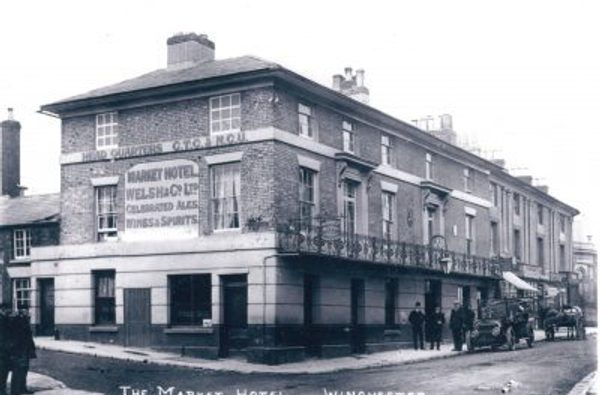
In 1914, the Simpkins brothers moved their whole operation from the Broadway to Jewry Street, converting the Market Hotel into the Theatre Royal.
They continued to host “Variety Acts and Pictures” for a year, until the pictures fell away and it became a full-time theatre.
It was likely during this time that Winchester got it’s first ‘flying matinee’ – the cast of big London shows would travel down for a weekday matinee performance for Winchester’s elite before heading back to London for their evening show.
In 1922 the building was converted into a full-time cinema and was one of the first cinemas to be wired for sound and display wide-screen films.
After being saved from demolition, it reopened as a full-time theatre in 1978 and has been Theatre Royal Winchester ever since.
More about the history of this building can be seen on this blog.
The Regent (Picture) Theatre
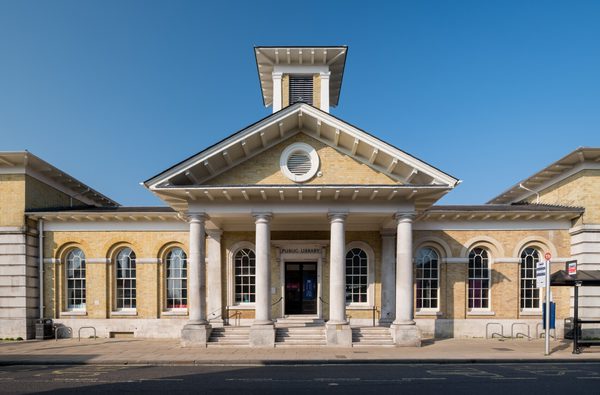
In 1915 the Corn Exchange, which was rather disused by this point in time, was adapted to become The Regent Theatre, complete with restaurant and tea lounge.
The theatre boasted a daily orchestra but it’s time as a theatre was short lived as it ventured into cinema in 1917, with Picture added to the name, before becoming a Dance Hall in 1922.
It then went back to being used as Regent Cinema in 1933 for three years before Winchester City Council decided to move the library out of the Guildhall and into the Corn Exchange building – the building we now know as The Arc. A combination of a library, cinema, theatre and art gallery!
Did you know that the ARC stands for Arts, Reading and Community?
The Chesil
The St Peter Chesil has stood proud on the River Itchen for many centuries as a church, just outside the former city limits.
However, it’s use as a church declined after WWII and 1966 saw the conversion of another building for theatrical use.
The nave and chancel became the stage and auditorium, the tower a wardrobe, props and committee room, the south aisle the green room, club room and a workshop space, and thus the Chesil Theatre was born.
In 2025, ambitious expansion work commenced, taking in the building next door, to include a light-filled entrance, a bar, a studio and community space.

The Nutshell
In more recent times the old Antique Market was transformed into a performance space in 2018.
Re-branded as ‘The Nutshell’ the venue is offered as an accessible place for creatives to use for rehearsals, workshops, exhibitions and small-scale productions.
Designed as a fringe venue, The Nutshell complements the existing theatre offer in Winchester perfectly, located directly in between the Chesil Theatre and the Theatre Royal Winchester.


